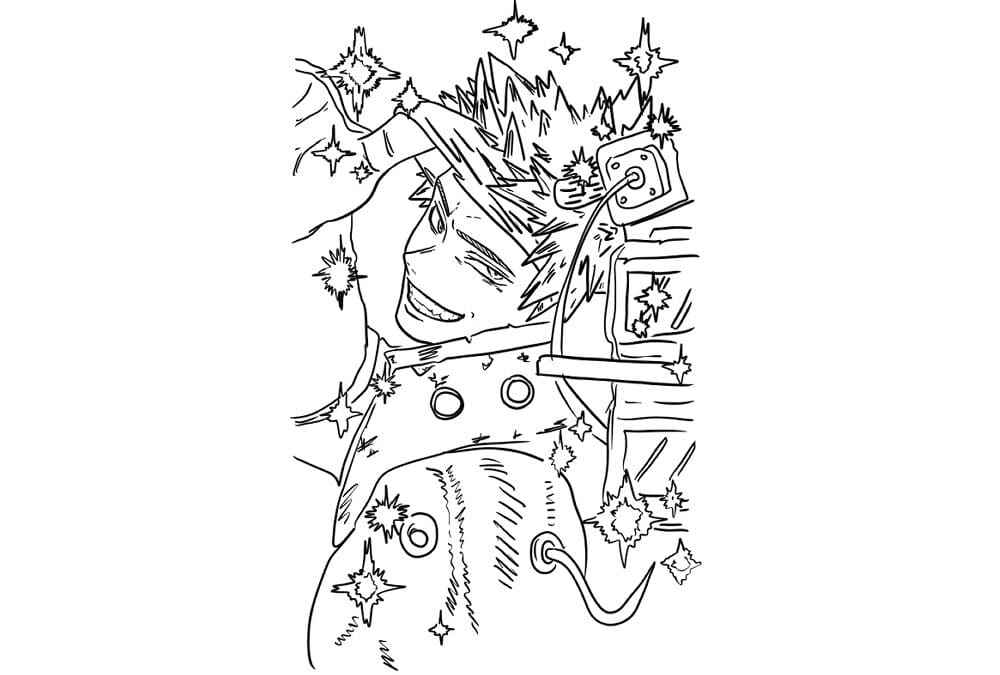
There is a specific type of fanfic reader who has, at some point, turned off their device, stared at the ceiling and started silently yelling.
Katsuki Bakugou.
Explosive, abrasive and embarrassingly well-written Kacchan has inspired more fix-it fics than arguably any other character in the MHA universe (at least, if you scroll through the Bakugou Katsuki tag for long enough).
And the question underneath it all is the same one: are we actually making things up, or are we just finishing what Horikoshi started?
Poppy Slater, 20, from Sheffield, has read enough Bakugou fics to have opinions about his characterisation. A lifelong MHA fan who got into the anime before she was old enough to fully clock what she was watching, she’s been thinking about this question longer than most.
“I don’t think fanfic exists because he’s a shit person and needs to be fixed,” she says.
“Towards the end of the manga and the anime, he is a decent person. He’s an asshole, but he’s a tolerable asshole. I also just wanted him to have a happy life.”
The fix-it as a genre is, in fact, often misread as corrective: the fandom steps in to fix a character the source material got wrong. But the way Poppy phrased it means we’re rejecting that entirely.
(Good) fanfiction doesn’t try to fix Bakugou for the sake of making him less of an asshole (particularly because it wouldn’t be Bakugou if he wasn’t a little bit of a shithead).
Fanfic is just a way to refuse to leave him at his worst. It acknowledges that yeah, he was a kid with rage and no one who knew what to do with it. But it also walks him towards the best version of himself not (just) because he owes anyone that, but because he deserves it.
So the aim isn’t utter change per se. The fix it is fixing the landscape and mentality around him, than the character himself.
The argument that fix-its could be canon is a way of saying: fanfiction did so well to help him, based on the groundwork the anime has already laid, that it almost looks canon.
On this point, Poppy is almost offended that anyone needs convincing.
“All throughout that whole monologue, he’s basically begging Izuku to come back to him,” she says, referring to the vigilante arc.
“That’s all it is. So there’s already the foundation and the roots there. It’s just our clever, impeccable brains that have gone, ‘yeah, we can turn this into something more.'”
The river scene. The apology speech. The Grand Beta fight, where Bakugou essentially cracks open and lets you see the entire architecture of his damage for the first time.
This is a character being systematically, and almost painstakingly, built for exactly the kind of emotional trajectory fix-it writers take him on.
“You say you want to be rivals forever, whatever,” Poppy adds. “That’s going to turn into something romantic. He’s going to have that personality. It’s just the way it is.”
So what does the fanon actually add to the canon?
According to Poppy, the most significant thing is the most basic: the sense that he is a full human being rather than a plot function.
“It shows him having more of a personality. He’s an actual person. He’s not just this rage machine.”
The anime, by necessity, keeps Bakugou in hero mode. You see him training, fighting, competing, bleeding. What you don’t see is him just existing outside of being a hero.
The domestic AUs, the mundane AUs, the ones where he’s just in a kitchen being insufferable about how someone else cooked something.
“You don’t see him a lot—just him, without the weight of being a hero on his shoulders. You realise he’s so different to what is just shown in the anime.”
The traits that the fanon has collectively agreed on are telling in their specificity.
Firstly, jealousy.
Not the competitive kind, but the personal, gnawing kind.
“Not even towards just being better than Izuku,” Poppy says. “It’s jealousy of everybody else around him.”
His obsessive attention to detail, hinted at in canon and extrapolated into something vivid: “You sort of get your toes dipped into it a little bit, when you see him cooking at camp and he’s like, ‘what have you done with these chives, Todoroki?'”
And then there’s the blood pressure headcanon, the fan theory that the nitro-glycerine in his body keeps him in a state of physiological agitation, which Poppy admits she was genuinely convinced was canon until she went back to check.
“I was like, ‘oh my god, wait, that’s actually not canon.’ But that’s a mad trait.”
What all of these have in common is that they’re extrapolations, not inventions. They take what’s there and follow it to its logical conclusion.
“In most of fanfics, where they build on who he is, you’ve already got that base level, but they’re just extending it a little bit.”
And underneath all of it, there’s the thing that doesn’t get said enough in canon.
“He cares about people in ways that are unusual, but once you get to know him, you realise how nice he really is. The way he speaks to Izuku, it’s like he’s pushing him to be a better person. And that in its own sense is caring about someone.”
Secondly, therapy.
The therapy arc is practically a genre unto itself within Bakugou fanfics, and if you want the gold standard, Poppy points to The Way You Used To Do (this fic is heaven on earth just saying).
Those kind of longfics (this one’s close to 700,000 words) contain the kind of characterisation that feels so earned you have to remind yourself it isn’t canon (I’ve had to do it myself many times…)
“Therapy is just an easier way to write a fanfic. You can have him not go to therapy and realise himself, but there’s going to be a ton of angst in that.
“I think therapy is just sort of an easy way to get into that ‘maybe I’m a little bit not a great person, maybe I need to change.’ He’s already somewhat there anyway.”
This is actually a precise observation about writing. Post-war, post-everything, there is a version of Bakugou who has every narrative reason to be sitting in a room talking to someone about it.
The therapy fic isn’t fantasy as much as it is a fairly realistic projection of where his arc was always heading. Writers just get there faster.
But there’s a version of Bakugou in fanfics that Poppy has no patience for, and it gets to the heart of the delulu question: how much of what we’re writing is genuine extrapolation versus wish fulfilment dressed up as character analysis?
“I think it’s a normal amount of delulu,” she says.
The fix-its that hold up are the ones that understand this, that his growth doesn’t mean he becomes soft, it means the aggression finds somewhere productive to go.
“He’s an actual person. He’s not just this rage machine.”
And that means the full person, not a sanitised version of him.
The loneliness question is where things get even more interesting. Because Bakugou, in canon, is not struggling. He has a family, a quirk, friends who inexplicably adore him, and a clear professional trajectory.
By any external measure, he’s fine.
And yet.
“I feel like even in the anime, it shows he’s quite lonely,” Poppy says. “He goes to bed at eight. He doesn’t really talk to any of his friends because he feels like he can’t relate to them.
“It’s a specific kind of isolation, the kind that exists inside a full life, invisible from the outside.”
That’s the emotional engine of the fix-it: not correction, but completion.
On the question of forgiveness, which surfaces whenever Bakugou’s childhood behaviour gets relitigated, as it does, cyclically, in every corner of this fandom, Poppy is brisk.
“If you can’t forgive him for being a bad person as a kid, you’re probably a bad person. Because I know I have done things in my past that I regret.
“Deku literally says he doesn’t care about it anymore. He’s over it, so why should we not be?”
It’s a clean argument, and it sidesteps the moral accounting that tends to dominate these conversations. Forgiveness isn’t a reward Bakugou earns. It’s something the narrative gives him with character development, in time, with a whole lot of patience and angst.
So: could fix-its be canon?
“Inevitably, you’re going to wind up with it being canon either way,” Poppy says.
“Whether through a fanfic or the anime, he’s going to change and grow and be a better person, just like in any other anime you watch.”
She points to Endeavour, another character whose redemption arc felt impossible until it didn’t.
“If the writer would have continued their story past the war and them being pro heroes, you would have seen that change. You would have seen him be a better person and learn to love more and appreciate things.”
So this is it. The fix-it, here, isn’t an alternative to canon, but it’s the canon with some patience to get to the finish line.
Poppy’s final word on the subject is the craziest exit line I’ve ever heard: “Beauty is in the eye of the beholder.”
She’s right, obviously. After all, some of us have been staring at the same screen for fifteen years now, and we know exactly who we’re looking at.
You did well, Kacchan.