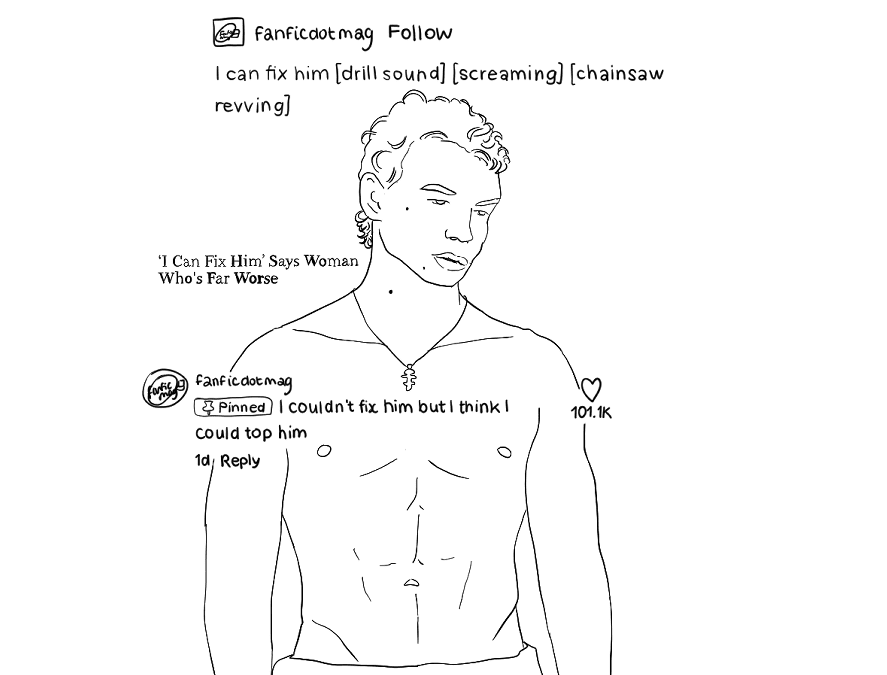
From Hardin Scott to Ilya Rozanov, fanfic readers are constantly crushing on male characters who need therapy, a bath and better communication skills. In reality, we know these men would be exhausting to deal with, so Livvy is finding out why we keep falling for them on the page?
“You need to touch grass and go outside.” Megan’s face dropped as her friends expressed their concern after she had brought up Sirius Black for the fourth time that day. Stuck inside during lockdown, she became lost in a Harry Potter fanfiction.
Her friends questioned: “Why Sirius over Cedric Diggory? He is so moody” and she realised that she actually could not answer them. She did not know why.
Fast forward to now, Megan is in a committed relationship but still has ‘moody’ fictional characters in the back of her mind. Sirius has now been emotionally retired and instead she has redirected her affections to Kaz Brekker, from Six of Crows, because, clearly, traumatized fictional men are her ‘type’.
If these emotionally twisted characters are often so explosive and dark, why are they so appealing to the reader? Why Sirius Black? Why Kaz Brekker?
Megan said: “Kaz does intolerable things, but he is written in such a likeable way which makes him attractive.
“I am most drawn to the ‘avoidant’ personalities, and I think it is because they are unattainable. I would never go there in real life, but I have the freedom to do it in fanfiction.”
Megan is in a group chat with over 100 people to talk about fictional characters and they have noticed some common themes with the ‘attractive stereotypical villain’.
She said: “They all have a deep backstory, and they always seem to redeem themselves throughout the fic.
“You don’t get that with evil guys in real life. Kaz literally kills people but treats his love interests better than how some of my friends treat their partners.”
Flaws can create appeal through tension, which blends into real lives where people can be drawn to emotionally distant partners because of ‘the thrill of the chase’ and the belief that you can change them. The only difference is, in most fics, it is almost always guaranteed that you end up with the boy, rather than the reality of suffering through heartbreak.
It’s not just readers who recognise this appeal. Sophia started writing fanfic at twelve and her friends would pay her, at school, for custom one-shots. Still writing now, she gives her characters ‘little flaws’ and believes that attraction comes from wanting to feel ‘different’ and being the only person who is able to reach someone.
She said: “You see this person and they’re not giving you what you want, but you feel like you could fix them, and you could be the only person who can make them open-up and finally love.
“If you are the only one who can do that, then you feel special.”
She joked that some fictional characters are thrilling on the page but would be terrible to date in reality.
She said: “It is simply not healthy to have some of these relationships in real life.
“It is fun to explore something fictional because it is safe.
“In some stories, the reader will get kidnapped by one of these characters and fantasising about that could be satisfying but that would obviously be dangerous in real life. So, let’s keep that as fiction.”
Fanfic allows us to explore characters and project desires into them safely without any real-word consequences.
However, that safety can come at a cost.
When readers are exposed to an overwhelm of intense devotion, it can influence what feels acceptable in real life relationships. You will never be ghosted in a fanfic, but modern world dating often lacks clarity, which leaves messy consequences. It is unlikely that some will end their real relationship due to fanfiction, but it can leave readers dissatisfied as it is impossible to compete with stories that are designed to emotionally fulfil.
This pattern is rooted in experience of being rewarded for improving the behaviour of others. If you were a teacher’s pet in school, you will understand the feeling of pride when the ‘naughty’ child was moved to the seat next to you, so they could mirror your behaviour – and then being praised when they finally became a better person.
As both Megan and Sophia’s experiences suggest, the appeal of the fictional “bad boy” isn’t just a modern fandom quirk but something that runs deeper. Forming attachments and interpreting desire shapes fantasy from an early age which is rooted in psychology.
Counselling psychologist, Dr Mari Kovanen says that fictional thirst stems from relationships that were made when we were young.
She said: “We are drawn to a dynamic that reminds us of what we grew up with.
“If you had a preoccupied father, that could be your first role model of a man.”
Dr Kovanen also expressed that fantasy is driven from imagination.
“In fiction, we do not actually know characters, so our brains like to fill in the gaps.
“These empty spaces are filled with our inner urges that are often buried. This comes from childhood, where we are fed stories about being saved by a knight or a prince.
“But it is not real life.”
These early influences can also shape as what we later perceive as exciting in relationships.
Dr Kovanen added: “Bad boys are appealing to us because the element of nervousness is there, and our bodies often confuse nerves with excitement.
Childhood influences only become an issue when you allow them to affect your real-life relationships. Dr Kovanen says that this can come from detaching from your partners flaws, avoiding them and not speaking to your partner about their problems.
It just isn’t fair to compare a beige real-life relationship to a thrilling ‘enemies to lovers’ storyline that you would find in fanfic.
Dr Kovanen said: “Any good relationship requires work and effort, but fantasising is a lot easier.
“However, part of a relationship is working with what we have in real life, rather than fantasising.
“We can help ourselves by focusing on what’s in front of us and avoiding comparison, remembering that we don’t truly know these characters and can’t selectively transfer their traits into real life.
“It is not pick and mix.”
Dr Kovanen highlights how personal experiences are grounded in science, showing emotional patterns and how they can shape the appeal of fictional characters in both fantasy and real-life relationships.
This explains Megan’s own reflections on her relationships with these characters. Psychology influences what she finds appealing as she learns how to separate fanfiction from her real-life emotional needs.
Still, the pull between fictional intensity and real-world perfection remains.
Today, Megan believes that certain characters have raised her real-life standards. Fanfiction acts as an escape from reality but it cannot replace reality, which Megan understands and even though she loves her current partner, her fictional love interests will always remain in her heart.
She said: “No hate to my boyfriend. I love him, but sometimes he will say something, and I just think, ‘Kaz would not say that.’”
Megan’s thoughts suggests that it is about understanding why the dangerous fictional character feels so compelling as well as knowing when to step back from it, close the tab and, as her friends once told her, ‘Go outside and touch grass.’