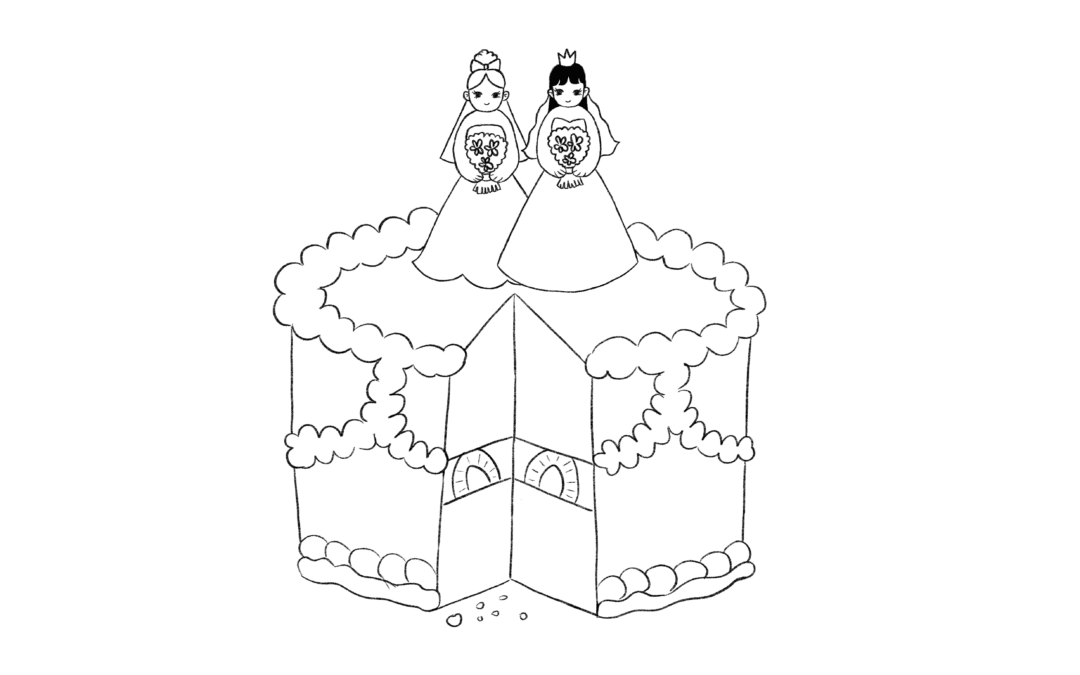
For a long time, loving lesbian women on screen meant learning how to lose them.
We’ve been there: watching Lexa die on The 100, clinging to Brittana’s stolen glances and chaste pecks in Glee and dissecting the doomed, messy energy between Needy and Jennifer in Jennifer’s Body. Representation for WLW was scarce, tragic, fleeting and toxic. Happy endings were rare and seeing ourselves on screen felt like a luxury; a cruel tease we almost didn’t dare hope for.
When the shows failed us, naturally, we turned to fics. Late-night scrolls on AO3, Wattpad and Tumblr to get a hit of some “slow burn” a little “domestic fluff” whatever you’re into it’s out there. These tags remind us: you’re not alone. Yes, other people are picking up on that vibe between Becca and Chloe in Pitch Perfect.
Fanfiction lets queer women be at the centre of stories, rewrite the endings and build communities where we could be celebrated, not given a half-assed poorly written deathbed confession so that the ship sinks before it even sets sail. It reminds us the bare minimum we saw on screen was not the only way we could have lesbian romances.
For some, fanfiction was once the only way to find any positive lesbian media. In some countries being gay is still a crime. That was the reality faced by one fan who we’ll call Vamp for her safety.
Vamp, like many of us, used to read into the subtext to find queer stories.
“I used to watch a lot of Disney shows and I was really into Jade from Victorious. I was lowkey shipping them [Jade and Tori],” – *sigh* weren’t we all?
She scoured YouTube for glimpses of love she could actually relate to. “I remember Bubblegum and Marceline, back home that relationship wasn’t shown on TV, but I found it online and I was like, OMG, they’re actually a thing! I didn’t know that because on TV they were just ‘friends.’”
Back then (the early 2010s) all Vamp had was fanfiction and low-budget GL series: “I watched all the low-quality shows, no matter the language, as long as there was a GL plot. And I was obsessed with watching compilations of side characters on YouTube.”
She even remembers sneaking in stories over breakfast: “I was so bold, I was literally reading Wattpad at breakfast before school, and my mom would brag, ‘my daughter reads in English’ haha.”
It’s funny, isn’t it? Straight couples get all the tropes: enemies-to-lovers, fake dating, dramatic breakups and aesthetic soft-focus love stories like K-dramas. And us? We got Blue Is the Warmest Colour, with its relentless sexualisation and age-gap framing, Below Her Mouth, which trades emotional depth for constant sex scenes, or Gia, where queer desire is entwined with self-destruction and tragedy. Even shows that tried to centre queer women- like early seasons of The L Word– often veered into melodrama, obsession, or the “tragic queer” route. It felt like queer women couldn’t just fall in love.Their love had to be a problem, a spectacle or a moral lesson.
Fanfiction spaces provided those endless romance plots queer women craved in all the ways we never saw on screen. They built audiences. We learned to care deeply about things like chemistry, pacing and emotional payoff. Fandom didn’t just consume GL, it cultivated the community that’s been set loose today.
When Thai GL arrived, we were ready and hungry for more.
Kristen Leclair, is a Social media manager and mother of two from Canada’s East Coast, with a rapidly growing social media presence. Her handle is Year_in_review on TikTok, Instagram and Youtube and she’s gained over 20k followers across the platforms with her content talking all things GL and BL.
Kristen discovered GL through FreenBecky’s The Loyal Pin. Although already a fan of BL, she quickly realized the emotional pull of watching queer women on screen “When you are watching women as a woman, it does draw you in more, emotionally.”
What started as a simple social media experiment turned into community: “I was just looking for people to talk to, to be in a positive space… I ended up meeting some people that I now call my family. There’s nine of us; we’ve been in a group chat for 3 years, and we talk every single day”
Kristen’s experience reflects how our fandom spaces have evolved into global, cross-generational communities all over the internet and the world, an extension of the same audience-building energy that fanfiction once cultivated.
Undoubtedly, Thai GL is in its golden era right now…and it just keeps growing! But its Gay counterpart BL has been around for over a decade now. For years, producers saw BL’s success and knew queer stories could sell, no question… but…GL? Risky.
By the late 2010s, BL had become a serious economic force. The Thai BL market alone is projected to generate over 4.9 billion baht (~$140 million USD) in revenue by 2025, growing at around 17% year‑on‑year and taking up more of Thailand’s entertainment output than ever before. The genre’s share of the broader media market was expected to jump from 0.7% in 2019 to 3.9% in 2025 – a huge shift for content that started with platforms like YouTube rather than traditional TV schedules.
Crucially, BL didn’t just draw eyeballs – it drew wallets. Fan meetings sold out. Actors became brand partners. Merchandising, global demand and live events turned screen chemistry into real money. In an era where traditional advertising revenues have been sliding, BL has become a new reliable cash cow.
But GL didn’t enjoy that same early confidence.
Even though Thai creators had been making queer content for years, it took until 2022 for the first full‑length GL series, Gap: The Series, to air – nearly a decade after BL dominated screens. Part of that was about gendered assumptions in the industry; BL was seen as something heterosexual women would enjoy and spend on, while GL was perceived as a smaller, harder‑to‑measure niche tied more directly to queer women (an audience that, historically, hasn’t shown up in traditional rating systems the way mainstream executives expect).
That invisibility mattered in an industry obsessed with metrics. If it couldn’t be counted, it was written off.
When Gap: The Series finally dropped, it didn’t just prove GL “worked” it revealed that an audience had been waiting the whole time… and a global one at that. After that first premiere, the GL landscape changed fast. By mid‑2024, we had eight full‑length GL series, with more in production and international fandoms forming around each one. Today, GL content is not only growing in quantity but being embraced across borders, from East and Southeast Asia to Latin America and beyond.
So the hesitation wasn’t about risk, it was about visibility. The audience had always been there. It just hadn’t been counted until now.
If fanfiction taught us to ship, Thai GL learned to sell the ship.
Much like K-pop groups, GL pairings are cultivated as brands. Collecting photocards, buying limited-edition merch, attending events, this isn’t just a bonus; it’s central to everything. The intimacy we once imagined in fanfiction is now produced, staged, and monetised.
Take LingOrm, whose chemistry transcends screen: their EMV dominance at Paris Fashion Week as Dior ambassadors shows how GL pairings are now global commercial powerhouses.
Izzy Otley, is a long-term GL fan and she’s drawn to the unique appeal of set pairings: “There’s something comforting about knowing that your pairing will definitely have another show together. It’s like AUs in fanfiction, you get to see them play out different roles and dynamics which is not something you get to see in western media because shows can just get cancelled out of nowhere and the actors never interact again”.
The industry didn’t create our obsession, it capitalised on it, turning the emotional labour and love we’ve poured into ships into a marketable commodity.
But this comes with a cost. When relationships are a brand, boundaries can blur. Fans expect intimacy and the actors are pressured to maintain chemistry off-screen. When GL actress Freen Sarocha was filmed by a stalker kissing her then boyfriend Seng, it wasn’t just a personal violation it was a potential threat to the FreenBecky brand.
The parasocial bonds and toxic expectations are something we unfortunately know all too well in the fanfiction space where real people are cast in imagined scenarios like it’s the most natural thing in the world. Vamp feels this can be a slippery slope: “When you consume too much of this media and you forget that it’s just media and not real life you get too involved in other people’s lives.”
Even shows trying to innovate, like the currently airing GirlRules, tread carefully. Multiple pairings are featured in the show but swapping committed pairings permanently on-screen is still unthinkable. The emotional and financial logic of branding the relationship is powerful and often protective, but it can feel restrictive for both fans and performers.
But…look at us now. From scrolling AO3 in the dead of night to watching LingOrm headline global campaigns, the leap is unreal. Young queer women can finally see themselves fully, happily and center stage.
Fanfiction didn’t just fill the yuri void, it built the foundations. It was our first taste of fleshed out WLW stories. Our non-canon imagined fics are now dwarfed by a multi-platform, globe-spanning phenomenon.
And yet, the magic hasn’t left. It’s still us: the fans who refused to let queer women be erased. We survived on crumbs. We fought for these stories. And now? Now, we finally get the full, unapologetic meal.