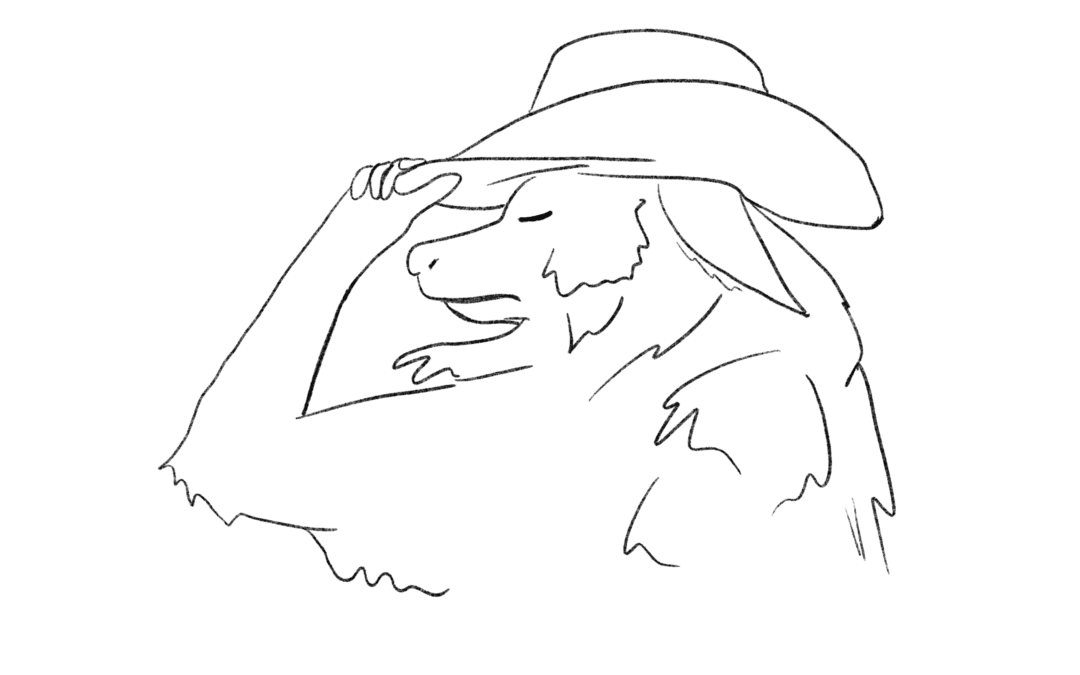
The Omegaverse is weird.
Full stop.
It just is, there’s no hiding that.
I feel like whenever someone asks about it I have to pull up a PowerPoint.
I need you to sit down, a long time ago there was a show called Supernatural…
It’s the sort of trope that on paper shouldn’t work because there is just so much going on and yet it’s become so recognisable.
The trope has come a long way from its Supernatural shipping origins and now exists as a genre in its own right.
So, why has something this outlandish continued to be so loved?
For most people, the Omegaverse isn’t something they consciously go out searching for, it sort of just finds them.
Feifei, 22, who is a freelance fiction ghostwriter first came across the Omegaverse through reading other fanfictions on Wattpad.
“My first reaction was genuine confusion,” she says. “The terminology was
completely strange to me at first.”
“What’s a heat? What’s knotting? What does any of this mean? I had to piece it together from context across multiple stories before it clicked. But once it clicked, I was genuinely hooked.”
She’s now grown to enjoy the trope and highly respect its writers.
“Good Omegaverse writing builds a whole system and commits to it completely. I found that really compelling as a reader. There’s a craft to it that I don’t think gets enough credit.”
That familiar system is not a coincidence as the Omegaverse operates on a set of recognisable patterns.
According to Martine Mussies, 39, who is doing a PhD in fan studies at the Centre for Gender and Diversity at Maastricht, the Omegaverse is a ‘speculative fictional universe’ which at its core is an ‘alternative biological and social hierarchy’ based loosely on the biologist Mech’s 70s theory about alpha male wolves.
“He had to debunk this whole argument but it already gained traction. So I think that’s also something that really struck me, that it’s basically all built on one big misunderstanding.”
She also says that the trope challenges ‘traditional’ understandings of power in romantic relationships.
“It biologises the power dynamics and it removes moral agency from the equation.
“Vulnerability and strength are explored without any judgment, because the character is not actively choosing to be dominant. They just are; their biology just compels it.”
Wynne F. Winters, 35, is an independent romance author and editor and well versed in fanfiction (started with Marvel and Sherlock and all that jazz) and first got into the Omegaverse through reading Attack on Titan doujinshi.
They’ve just started writing their first omegaverse book and they see the omegaverse as something that ‘plays’ with genre tropes ‘but also throws in that disproven study about wolves’.
“You have to have at least the three genders; you have to have heat; and they have to be overwhelming to the Omega; and you have to have pheromones.
“The actual framework itself is very strict but it allows for a lot of playfulness for people who are bored of heteronormativity. There’s almost never any mention of someone being gay, because what does that mean in that world.”
Those shared expectations create the foundation of the Omegaverse and the writers turn that foundation into whatever works for them and the story they want to tell.
Shasta de Leon, 38, author of Omegaverse novels says, “There’s so much that you can draw from and there’s that built in tension. They have to go to jobs, they have to pay taxes, but they also desperately need a fucking Omega, you know.”
Shasta’s stories explore lots of different elements including the concept of different types of relationships.
“I also just like the poly elements of it, where I can have five different love stories going on at the same time and they’re centered around your main character. I just feel like the possibilities are endless.”
She continues, “I think part of that is that it always comes down to their needs and their desires and their internal battles. So there’s so much more you can do.”
This challenging of societal norms also applies to gender. Just ask Wynne.
“My favourite thing about the Omegaverse is the gender fuckery of it all. As a non-binary person, I personally experience gender dysphoria, and so for me, the Omegaverse is a place where I can explore different bodies and different genders.”
For readers, that balance between batshit crazy and being extremely progressive is what makes the Omegaverse so fascinating and gripping as a trope.
Feifei says, “It’s easy to dismiss because of the unconventional premise, but the Omegaverse has a literary tradition at this point.
“That’s a community with standards and history. It developed on its own terms, without gatekeepers deciding what it was allowed to be.”
Obviously it’s not all glowing reviews for the Omegaverse. There are some valid criticisms of the trope.
YooJoung Nam, 27, is doing a PhD in English Literature at Ewha Womans University and her experience of the Omegaverse is through Korean and Japanese BL novels, which despite the use of this trope (and the fact that they’re BLs), weren’t actually that subversive.
“Most of the Omegaverse BLs had tropes where it’s kind of like a re-adaptation of traditional gender norms. There’s the very feminine bottom and the bottom will be getting pregnant
“So in Korea, there was this movement in 2018, where BL readers were like, ‘Oh, this is just re-adaptation of the misogyny in real life to BL’ and people started changing the trope.
“Before, the Omega was very petite but nowadays there’s Omegas larger in physical size than Alphas. It’s not just Alpha x Omega anymore. It’s Alpha x Alpha, or Omega x Omega, or even Beta x Beta.”
YooJoung thinks these changes help to create more convincing love stories.
“When it’s Alpha x Alpha or like Alpha x Beta, it shows they were not bound to fall in love, but they overcame it for the sake of love. And for the sake of love, they will continue loving each other.”
Then there’s the sex part (we can’t not talk about it).
The trope started off as a very kinky set of ships but has grown to mean much more. But there are some people, like Shasta, who consider sex as a core part of the genre.
She says, “I just don’t think it’s Omegaverse unless it’s bordering on eroticism. Because of all of the rules, it always comes back down to them forming packs to have sex, to have the heats because one of the characters is an Omega.
“The plot should always come back to their desire for connection and for romance and thus sex. Alphas and Omegas are sexual beings. And to erase that, I think is kind of erasing some of the general themes of Omegaverse.
“I always think that if I read an Omegaverse [story], and they seem to pull away from some of those ideas, that the author’s being a coward. I think that’s just one of the genre expectations is that everybody is going to be fucking and that it’s part of the plot.”
Despite this definite prevalence of sexuality and sex within the trope, Martine thinks that these are not the only pull for the audience.
She says, “The social dynamics can be kinky in nature. But I think that many people just engage with it for world building, relationship dynamics and social commentary.
“Because kinky content can be found in every fandom. Just because it’s more visible in the Omegaverse, that doesn’t necessarily mean that it’s limited to that.”
The Omegaverse hasn’t toned itself down in its rise to popularity. In fact there is probably a mind boggling fanfic being written right now and someone would definitely read it, because that’s how the community has grown.
“It’s really interesting because the borderline between the writer and the reader is really, really thin,” YooJoung says. “Writers become readers and readers become writers. So because the reader and writer relationship is so entangled, everyone’s participating in the creative process.”
This community-like attitude has also helped in the popularisation of the trope.
Wynne says, “I think because it’s so weird and it’s been an inside joke for people who are terminally online; it’s just sort of spread from there. I actually think that people thinking ‘that’s weird’, and joking about it has made it more normalised”
Shasta also agrees that the ‘cringe factor’ has played a big part.
“The fact that it’s kind of difficult to explain, and that it’s embarrassing to explain at times also is going to add to it being much bigger.”
If anything, that slight embarrassment is exactly what makes it more interesting.
YooJoung says, “It’s fun. It’s experimenting with what we cannot really see in real life. It’s interesting to see men get pregnant, even though it’s just text.”
So, the Omegaverse works because it gives its writers and readers a shared language.
One that’s structured enough to be reliable, but open enough to be reshaped and rewired.
It’s weird. It’s always going to be weird.
And at this point, that’s exactly why it works.