Three tabs open. Ten tabs. Fifteen. Blue light keeps you up at 3:16. Two-thirds through a 100,000-word romantic prose piece on a member of a disbanded 2010’s boy band. You’re propped up online, coffee in hand, with no hassling from publishers, no “cutting this down a bit”, no extra polite rejection emails doused in office-legalese. Every tangent is in there, with no compromise, mainly because you don’t consider the compromise; this is your work and not one ‘big cat’ has the authority to edit this Zayn Malik thirst-trap down.
Ok, maybe I’m exaggerating, but the modus operandi of fanfiction is excess. Not merely in word count, although there is plenty of that (stories longer than Ulysses based on an episode of Doctor Who) but an excess in feeling and wanderlust; going so far off the approved cultural path and forming your own scene. That’s what Archive of Our Own feels like: true spontaneity and free-form writing outside of any kind of traditional publishing house. People instinctively write for themselves, not for any kind of fixed audience.
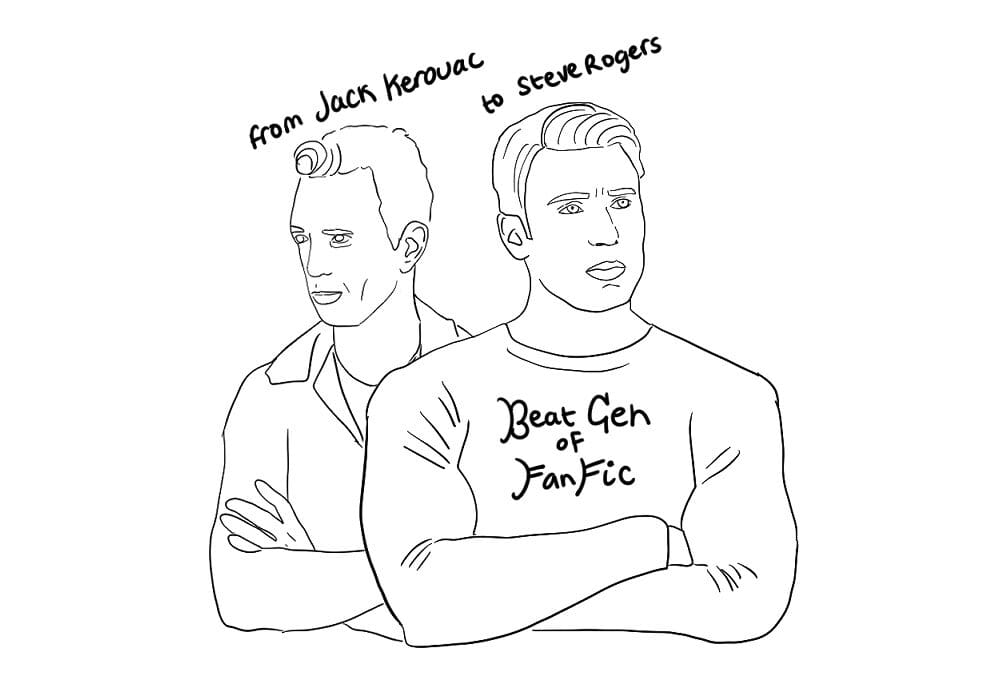
The Beat Generation would have recognised that instinct immediately.
Well, not literally. I highly doubt Jack Kerouac would’ve been hammering away on AO3 in-between scoring amphetamines and lounging in jazz bars. But it’s the DIY quality, the self-indulgence. The sense that official culture is far too slow and emotionally constipated to deal with what people actually want from writing.
This is what landed the Beats in hot water in the first place. They were seen as far too messy, too imprudent, too obsessed with sex, too obsessed with America and too obsessed with hating America. William Burrough’s infamous “cut up” techniques of borrowing prose from newspapers, books and anything else he could get his hands on resulted in his ‘breakthrough’ novel Naked Lunch. This was contemporaneously assessed as “utter babble” by Time Magazine.
And AO3 gets the same treatment now, 70 years on. The same sort of eyerolling. Something you’ll grow out of eventually. Which is rather strange if you ask me.
AO3 contains over 16,000,000 million works, with entire genres mutating in real time, whole underground subcultures and some unbelievably talented writers (think of your favourite), while traditional publishing finds it hard to market anything more radical than generic self-help books with an obligatory swear word in the title.
Paul Booth, professor of Digital Communication and Media Arts at DePaul University, and expert on anything fandom, described fanfiction’s role in literary canon.
He said: “I’d argue it’s part of the [literary] tradition. Fanfiction clearly belongs to a long tradition of rewriting and retelling, even if digital platforms and communal authorship fundamentally reshape how that tradition works and who gets to participate.
“Both fanfiction writers and Beat authors push back against the idea of the solitary genius author.”
The solitary genius author is usually an administrative fantasy anyway. It’s much easier for both publishers and the media to market one Great Mind or a Hip Priest than explain the concept of collective creativity, which is essentially what fanfiction is. There’s shared language, niches and ownership bubbling throughout both AO3 and the Beats.
Thus, the originality argument arrives. Fanfiction is dismissed because it rewrites existing material. But let’s be honest, the idea of popular literature being this constant original creation is untrue. Take Greek mythology, the stuff was endlessly rewritten and tweaked depending on location and century! Literature has always cannibalised itself; fanfiction just leaves the seams showing.
Which is probably why people find it so unsettling.
Fanfiction has never pretended that its stories are plucked magically from some singular genius writer having some Important Thoughts, it’s obviously collaborative by nature. Stories responding to canon, Reddit/Tumblr discourse, insomniacs posting suggestions to a slow-burn story at 4am, it’s shared works. Booth points out that “fanfiction has been written long before we had the term fanfiction”. AO3, Fanfiction.net or even the internet in general didn’t create transformative storytelling, it’s simply been industrialised.
The Beats had their own limitations, such as tiny print runs, speed shakes and a polarised media, but fanfiction seems to be resistant to that. People upload entire anthologies of their work and commenters are already dissecting each line of dialogue. In fact, fanfiction behaves far less like average literature and more like a constantly mutating conversation.
And that mutating quality is what makes so much of AO3’s content fascinating stylistically. There are long streams of consciousness, fractured chronology and great deal of repetition in the works of fanfic writers like opal_bullets and TrappedInPast, which is where the Beat comparison becomes hard to ignore.
Burroughs’ drug-addled prose. Kerouac’s spontaneous narration. Allen Ginsberg’s overwhelming sprawl. Maybe these are completely separate aesthetically, but they have the same rejection of restraint.
Booth goes on to argue that fanfiction “plays inside constraints – canon, genre, community norms – and finds freedom through remix and recontextualization”. This is a key distinction between the two schools. The stereotype of the Beat Generation is that they wanted to destroy the literary form completely, whereas fanfiction often works in existing structures instead, rewiring them until the canon is something completely different. A throwaway glance in a Harry Potter film can become its own 100,000 words plus relationship study.
Despite fanfiction finding its way increasingly into the public’s consciousness, there is still something that is undeniably countercultural amongst it. As Booth describes, there is “a tension in fanfiction publishing today between those that want to keep it non-commercial and out of mainstream eyes, and those that publish their work”.
This tension is important because every worthwhile subculture reaches this point. Punk became fashion within 2 years. Indie became TikTok music. Once there’s enough money going around, there’s always a risk of it going up in smoke. Fanfiction may be going through a similar process; with publishers traipsing through fandom forums and BookTok turning fanfic tropes into marketing categories (sorry if you use TikTok).
But AO3 and wider fanfiction still feels resistant. Probably because it’s driven by obsession. No sane person writes 300,000 words on a cancelled pilot show because they are thinking about career opportunities. They do it because the story got lodged somewhere inside their brain and they need to get it down.
This is probably the real connection between fanfiction and the Beats. Not much direct influence, or shared aesthetics or the idea of a Prole Art Threat or anything. Just the reoccurring appearance of people creating outside official approval systems because existing culture doesn’t feel capable of what they want to say.
Burroughs slamming away at a typewriter on self-prescribed Benzedrine.
Somebody on AO3 posting chapter updates on a new Twilight fic at 5:00am.
It’s the same impulse.